EV charger installation cost in Roseville
Homeowners reasonably want a number. The honest answer is that published averages are national, they do not agree with each other, and your house — panel capacity, run length, indoor vs outdoor — matters more than a midpoint. This page shows the figures we can source, what is usually in a quote, and how local rebates can change the out-of-pocket amount.
What a quote usually includes
A useful written estimate for a Level 2 install typically separates:
- The charger itself (sometimes owner-supplied).
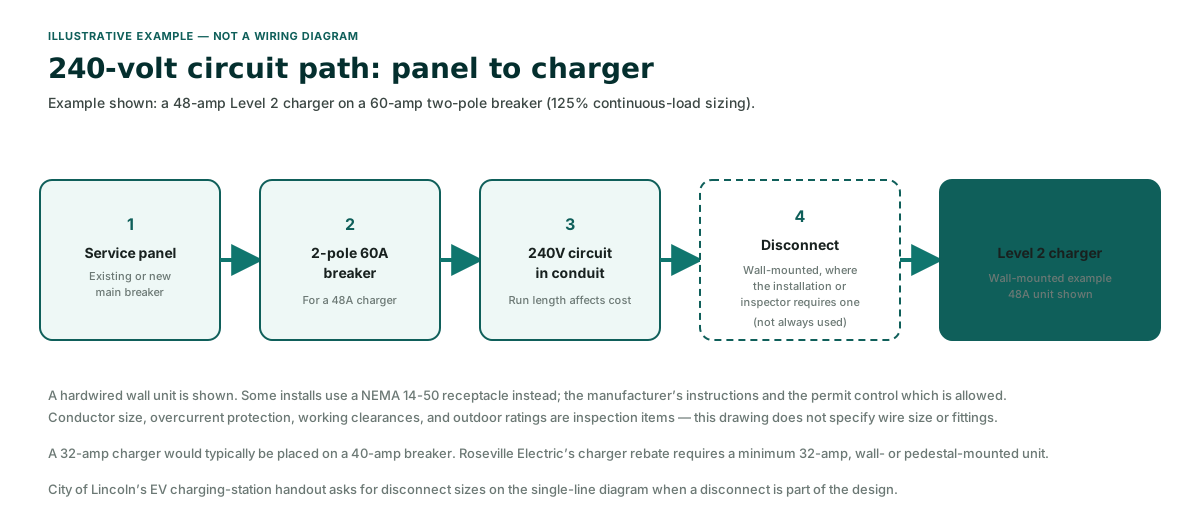
- The dedicated 240-volt circuit: breaker, wire or cable, conduit, and the disconnect or outlet, if used.
- Labor, including wall or attic fishing, outdoor weatherproofing, or trenching to a detached garage.
- Permit and inspection fees.
- Any panel work, subpanel, or load-management device, priced as its own line if needed.
- Whether the contractor will file the utility rebate and, if so, whether that is included.
If a bid is a single lump sum, ask for that breakdown. It is the only way to compare two electricians, or to see whether a “cheap” price omitted the permit or assumed you already have a 60-amp spare slot.
Published national ranges (not Roseville bids)
We did not find an official City of Roseville, Roseville Electric, or PG&E schedule of typical residential charger installation prices. Two national consumer sources, checked November 11, 2026, report different midpoints:
- EnergySage (updated October 20, 2025), citing Qmerit: U.S. average $2,442. Simple installations can be a few hundred dollars; significant electrical work can exceed $3,000. Level 2 charger hardware $400–$1,500. Electrician labor often $50–$100 per hour for a job that can take four to eight hours. Permits $50–$300 according to Qmerit data cited there. Load-management equipment “typically costs around $1,200.” A service upgrade to 200 amps is described as “$3,000 or more.” Subpanels $400–$2,000. Panel replacement “about $500 to over $2,000.”
- Angi (updated September 23, 2026, 4,398 verified projects): national average $967, typical range $555–$1,380. Level 2 all-in totals described as $700 to over $2,000. Electrical panel upgrades budgeted at $800–$2,000. Permits $150–$200.
Those midpoints are far apart, which is a reason not to treat either one as “the Roseville price.” Angi’s figure is based on its own pro-network jobs and may lean toward the labor-and-install portion of more straightforward projects. EnergySage’s Qmerit average may capture a broader mix, including more electrical work. California wages and materials can sit above a U.S. midpoint. Verify with local written quotes; this site does not invent a “typical Roseville” number.
What tends to drive cost here
In Roseville, Rocklin, and Lincoln, the same physical factors show up in almost every estimate:
- Panel capacity and spare slots. A 200-amp panel with an open space and a passing load calculation is the simpler path. A 100-amp or full panel can add load-management equipment or a service upgrade — often the largest line item. See panel upgrade for an EV charger.
- Distance and path from the panel to the parking spot. A short surface-mounted run in an unfinished garage is very different from conduit through finished living space, an attic, or a trench to a detached garage or side-yard parking.
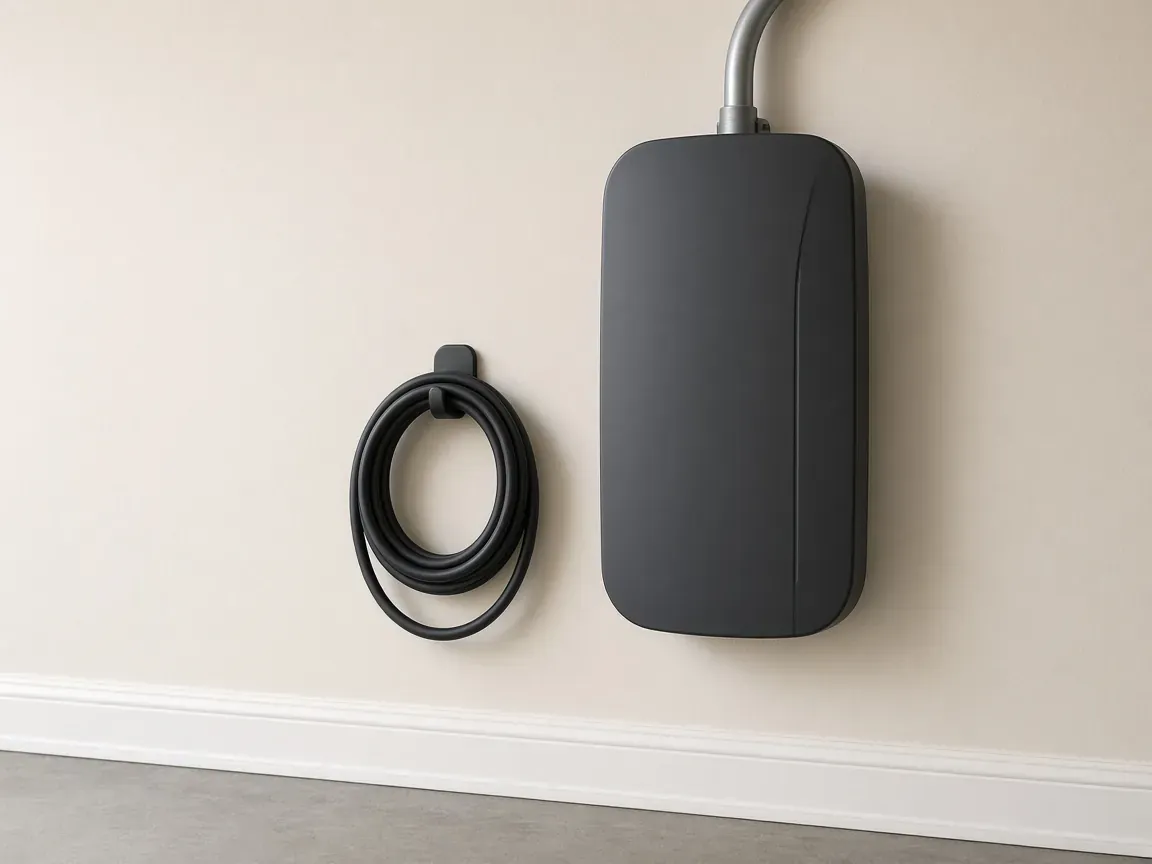
- Indoor vs outdoor mounting. Outdoor equipment must be rated for the location; pedestal mounts and longer exposed runs add materials and labor.
- Permit and utility process. Roseville, Rocklin, and Lincoln each have their own EV charger permit path. A service upgrade in Roseville requires written approval from Roseville Electric before the building permit, plus a scheduled disconnect/reconnect. Rocklin and Lincoln coordinate service changes with PG&E.
Housing in this part of Placer County is a mix of older infill and large planned communities built from the 1980s onward. Newer production homes are often built with 200-amp service; older houses may not be. That is a tendency, not a rule for any address. The main breaker and a load calculation decide it.
How rebates change the out-of-pocket amount
For Roseville Electric customers, the standard Level 2 rebate currently listed is $200, or $400 if you qualify through the utility’s rate-assistance programs. A panel replacement that meets that program’s rules may add up to $1,000. Details, deadlines, and open questions are on the rebate guide. These are offsets, not full payment, and funds can run out.
For PG&E customers (typical in Rocklin and Lincoln), the Residential EV Charging rebate’s standard option is up to 50% of the purchase price of eligible charging equipment after installation. The income-qualified Rebate Plus option lists up to $2,000 for installation of an eligible charger, or up to $5,000 when a panel upgrade is included, and must be applied for before a Trade Ally Network contractor buys and installs the equipment.
A federal Alternative Fuel Vehicle Refueling Property Credit (often called 30C) was widely described as covering 30% of qualifying costs, up to $1,000, for home chargers placed in service through June 30, 2026, and only in certain census tracts. This draft is dated November 11, 2026. Treat current federal incentive availability and any local census-tract eligibility as verify — do not count on that credit for a new install unless you confirm it with a current IRS or Energy Star program page or a tax professional.
How to read two quotes side by side
- Is the charger included, and is it a model that can meet Roseville Electric’s 32-amp / 15-foot cable rules if you plan to apply for that rebate?
- Is a permit included, and which city is listed?
- Did the electrician show a load calculation, or only a glance at empty breaker spaces?
- If a panel upgrade is recommended, is a load-management alternative explained, and is the upgrade priced separately?
- Who files the rebate, and what happens if the utility denies it?
A licensed electrician should be able to walk through those points in plain language. This site can pass your details to one when a partner is in place; it does not set prices or perform the work.
Request a quote
A local licensed electrician can review your panel, run length, and charger choice and give you a written scope. There is no obligation to hire anyone.