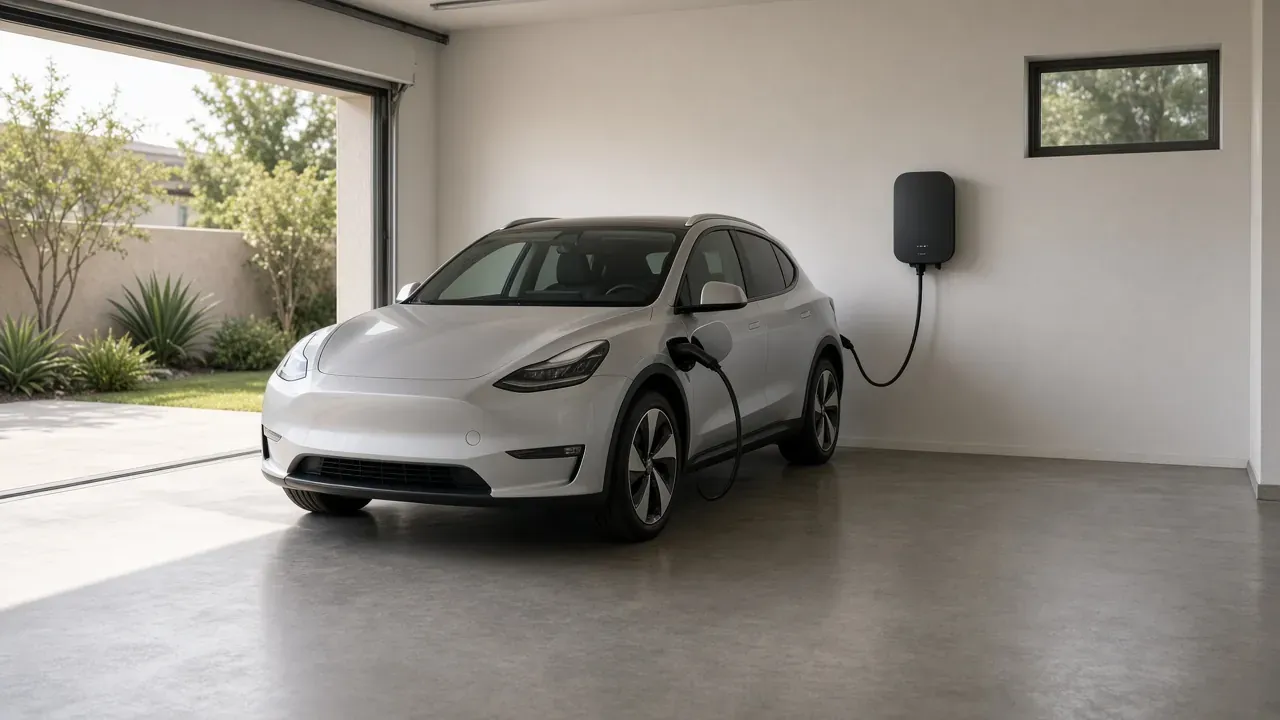
A typical home Level 2 charging setup in a contemporary garage. Illustrative image, not a local job photo.
Roseville, plus nearby Placer County communities
Level 2 EV charger installation in Roseville, Rocklin, and Lincoln
A straightforward guide to adding a 240-volt home charger — including the panel work, permits, and utility rebates that often come with it. Written for homeowners, not as a contractor sales page.
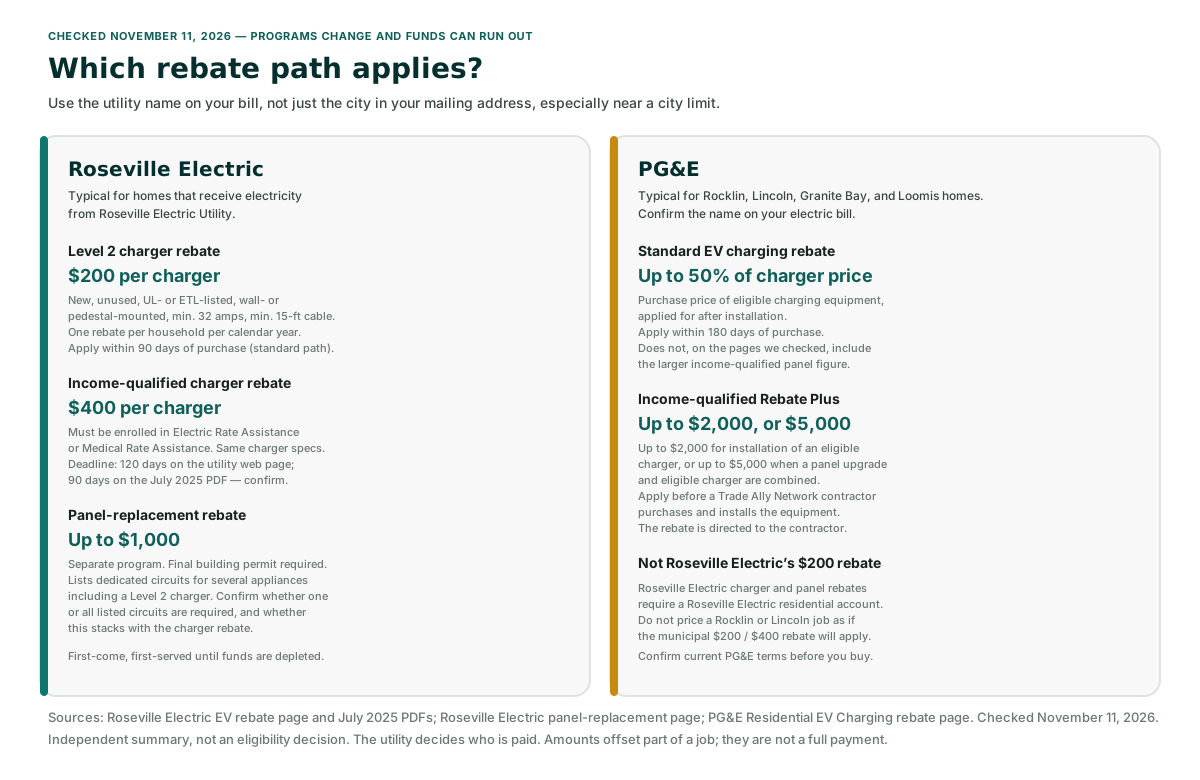
Roseville Electric currently lists a $200 Level 2 charger rebate, and $400 for income-qualified customers.
A panel replacement that meets program rules may qualify for up to $1,000 from Roseville Electric.
Rocklin, Lincoln, Loomis, and unincorporated Granite Bay homes are typically on PG&E, which has a separate rebate path and its own permit counters.
Rebate amounts and rules can change and funding is limited. Confirm current terms with your utility before you apply or buy equipment.
EV Charger Roseville is an independent guide, not an electrician. A request may be shared with a local licensed electrician. This site may receive a referral fee. There is no obligation to hire anyone.
What to expect
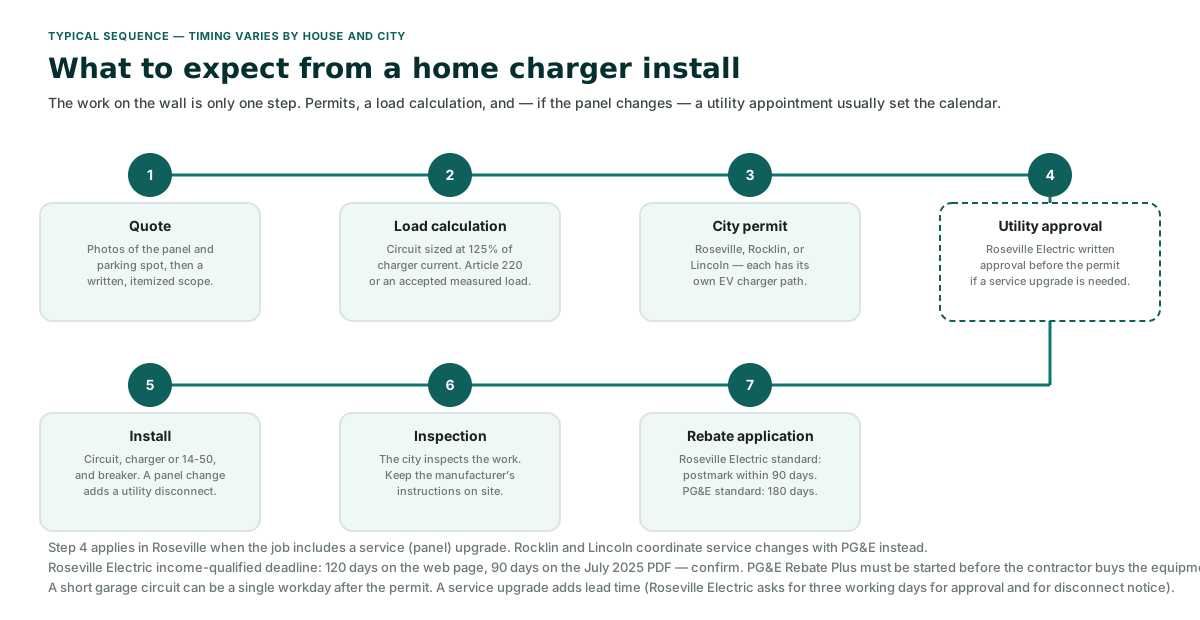
Most home Level 2 jobs follow the same sequence, whether the charger hangs in a garage or on an outside wall. The details — especially permits and which utility is involved — change by city.
A typical sequence, not a guaranteed calendar. Step 4 applies in Roseville when the job includes a service (panel) upgrade. Rocklin, Lincoln, Loomis, and unincorporated Granite Bay coordinate service changes with PG&E instead of Roseville Electric. Rebate windows differ by utility and program; confirm current deadlines before you file.
01
Photos and a load calculation
An electrician looks at your panel schedule, the path from the panel to the parking spot, and the charger rating. EV charging equipment is treated as a continuous load under the National Electrical Code, so the circuit is typically sized at 125% of the charger’s current rating.
02
Permit
Roseville, Rocklin, and Lincoln each have a dedicated EV charger permit path. If a service (panel) upgrade is part of the job, Roseville also requires written approval from Roseville Electric before the building permit. Rocklin and Lincoln coordinate service changes with PG&E.
03
Install
A straightforward garage run near the panel may be a single visit. Longer conduit runs, finished walls, or a panel replacement take more time and may involve a utility disconnect and reconnect.
04
Inspection and rebate paperwork
The city inspects the work. Roseville Electric’s standard rebate application must be postmarked within 90 days of the charger purchase. The income-qualified web page says 120 days, while the July 2025 PDF says 90 days — verify which window applies. Keep the invoice, photos, and final permit.
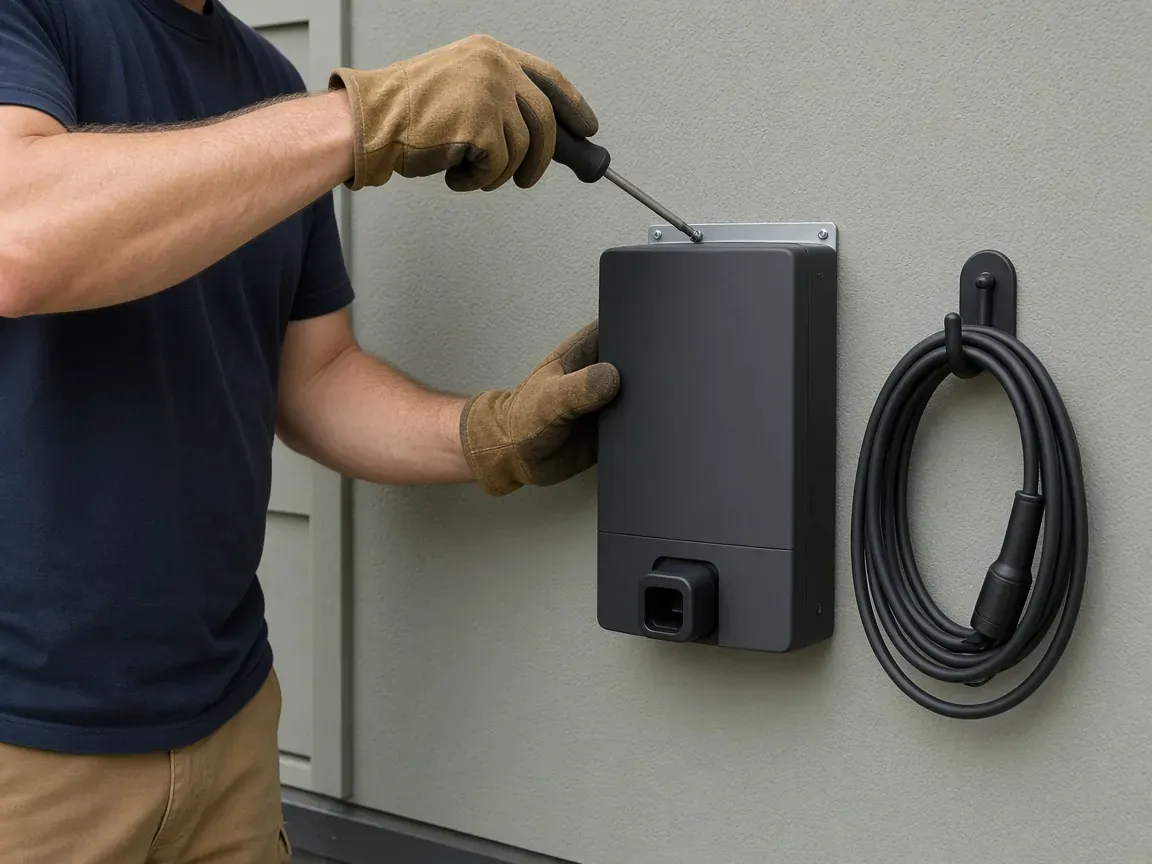
Mounting a wall charger is usually a short part of the job; the circuit, permit, and any panel work take more of the calendar. Illustrative image, not a local job photo.
There is no official City of Roseville or Roseville Electric price list for a home charger install. Two widely cited national sources disagree, largely because they count different parts of the job:
EnergySage / Qmerit (2025)
$2,442 average
EnergySage, updated October 20, 2025, cited Qmerit data for a U.S. average of $2,442, with simple jobs in the hundreds and more involved electrical work over $3,000. It listed Level 2 chargers at $400–$1,500, permits at $50–$300, and a service upgrade to 200 amps at $3,000 or more.
Angi (2026 data)
$967 average
Angi, updated September 23, 2026 and based on 4,398 verified projects, reported a national average of $967 and a typical range of $555–$1,380. It separately budgets $800–$2,000 for a panel upgrade and $150–$200 for permits, and puts Level 2 all-in totals at $700 to over $2,000.
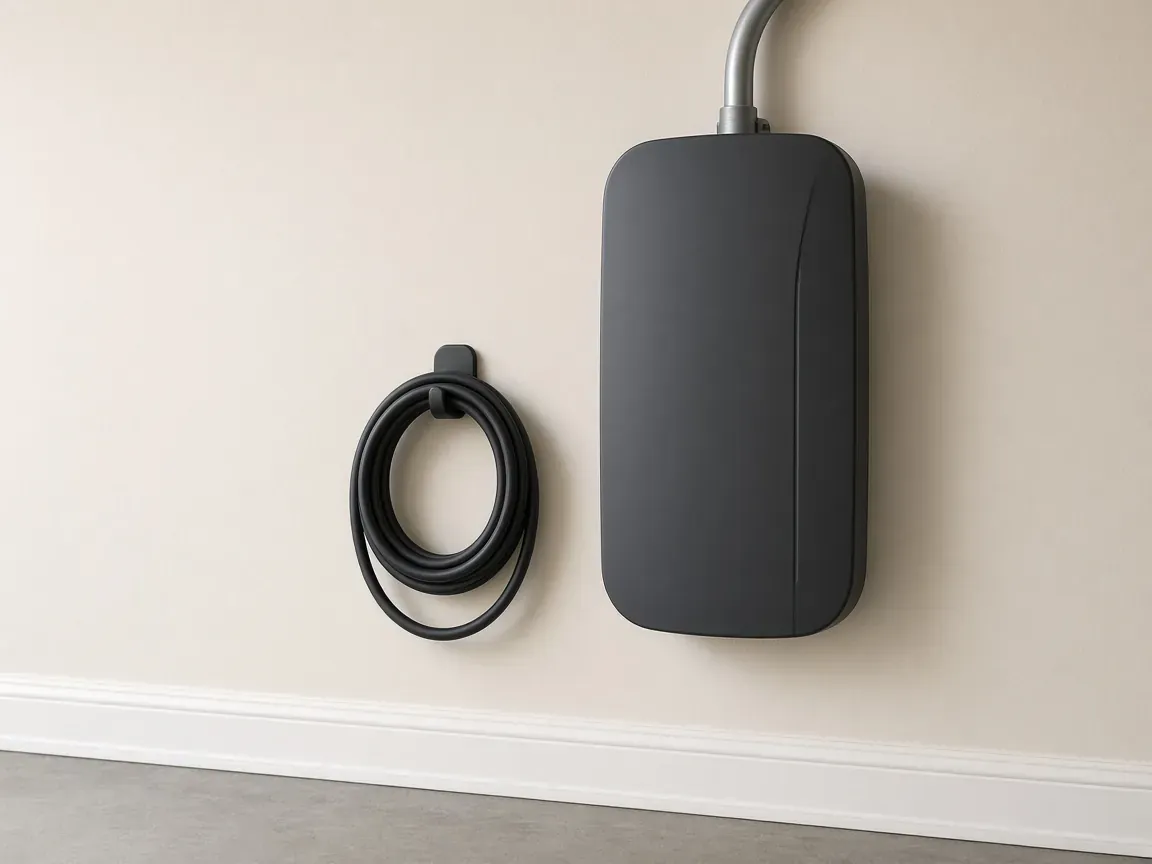
A tidy finished wall-charger install. What you pay depends on the circuit, any panel work, and the permit — not only the look of the unit on the wall. Illustrative image, not a local job photo.
California labor, permit fees, and long conduit runs can land above a national midpoint. The useful question is what is in the written scope: the charger, the circuit, any panel or load-management work, permit and inspection, and whether rebate paperwork is included. See the cost guide.
Roseville Electric rebates
If your home receives electricity from Roseville Electric Utility, two residential charger rebates and a panel-replacement rebate are listed on the utility’s site as of November 11, 2026:
Program
Amount listed
Who it is for
Level 2 charger rebate
$200 per charger
Roseville Electric residential account; new UL/ETL listed wall or pedestal unit, minimum 32 amps, minimum 15-foot cable; one rebate per household per calendar year; apply within 90 days of purchase.
Income-qualified Level 2 charger rebate
$400 per charger
Must be enrolled in Roseville Electric’s Electric Rate Assistance or Medical Rate Assistance program. Same charger specs. As of this check, the official EV rebate page and income-qualified catalogue both say 120 days after purchase; the July 2025 PDF application still says 90 days — verify which deadline applies before you apply.
Panel replacement rebate
Up to $1,000
A final building permit is required. The program lists dedicated circuits for a Level 2 EV charger, heat pump water heater, heat pump HVAC, induction cooktop, and heat pump clothes dryer. Whether one or all of those circuits are required, and whether this stacks with the charger rebate, remains verify.
Applications are first-come, first-served until funds are depleted. Roseville Electric notes that EV program funding from the state’s Low Carbon Fuel Standard has declined. Full rebate guide, eligibility, and how to apply.
Rebate amounts and rules checked November 11, 2026. Use the utility name on your bill. Income-qualified Roseville Electric deadlines still disagree between the utility web page (120 days) and the July 2025 PDF (90 days). Panel-rebate eligibility and stacking should be confirmed with the utility. Programs change and funds can run out.
Panel capacity and load calculations
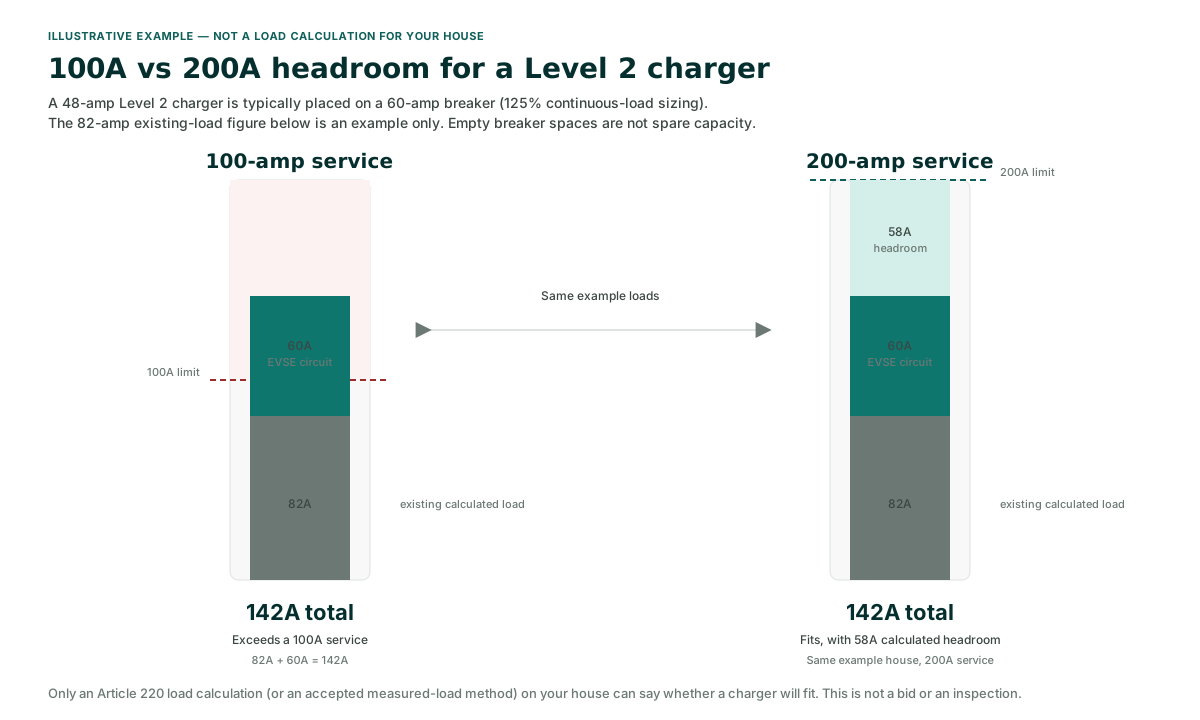
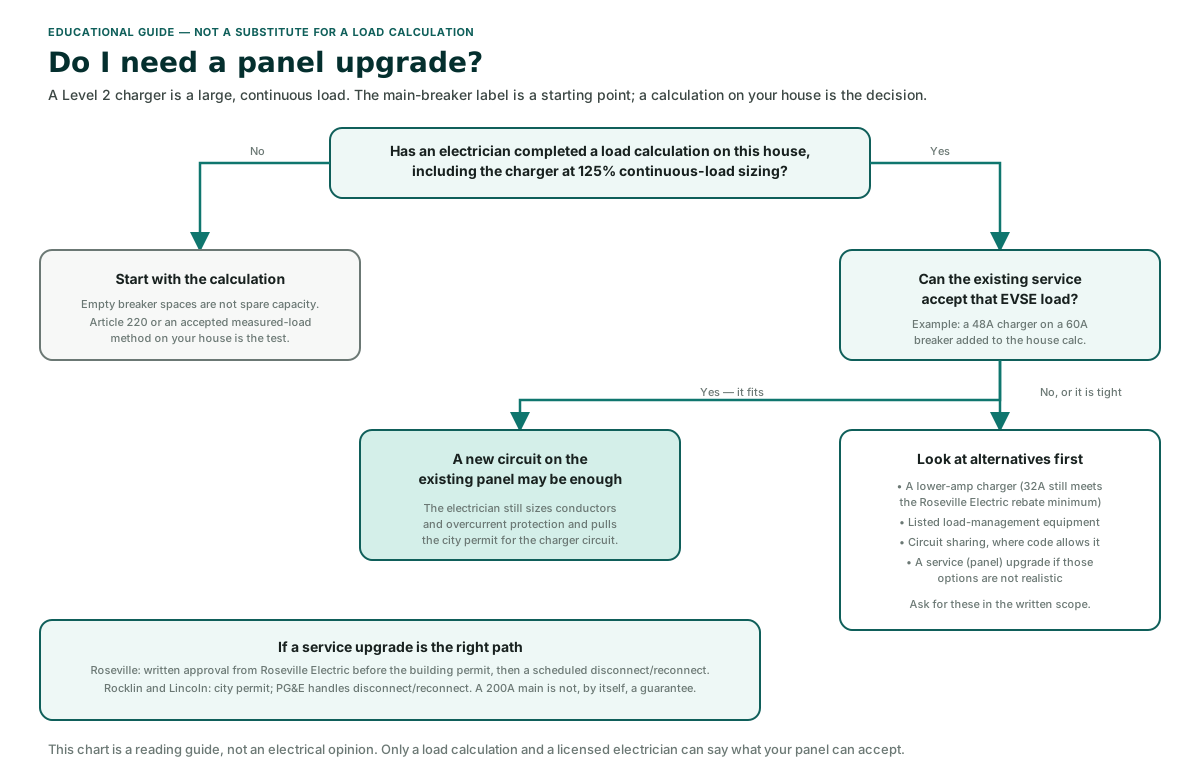
A common 48-amp Level 2 charger is typically placed on a 60-amp breaker because the National Electrical Code treats EVSE as a continuous load and requires conductors and overcurrent protection to be sized at 125% of the load. That is a large new demand on a 100-amp service that already serves air conditioning, a range, and a dryer. A 200-amp panel — common in many newer production homes — is more likely to have spare capacity, but “200 amp” on the main breaker is not a guarantee. The test is an Article 220 load calculation on your house, or a measured-load approach if the electrician uses one.
Illustrative example — not a load calculation for your house. A 48-amp Level 2 charger is typically placed on a 60-amp breaker (125% continuous-load sizing). The 82-amp existing-load figure is an example only. Empty breaker spaces are not spare capacity.
If the calculation is tight, options include a lower-amp charger, a load-management or energy-management system that slows charging when the house is busy, sharing a circuit with another large appliance, or a service upgrade. EnergySage has cited roughly $1,200 for load-management equipment and $3,000 or more for a 200-amp service upgrade; Angi budgets $800–$2,000 for a panel upgrade. Treat those as national published ranges, not local bids. Read the panel upgrade guide.
Service area
The three cities sit next to each other in Placer County, but they do not share a utility or a permit counter. Confirm the electric provider on your bill, especially on addresses near a city limit.
Roseville
City of Roseville residents are typically Roseville Electric Utility customers — a municipal utility, not PG&E. Permits run through Roseville Development Services. This is the only city of the three where the Roseville Electric charger and panel rebates usually apply.
Rocklin is typically PG&E electric territory. The City of Rocklin Building Division issues the EVSE permit. PG&E’s Residential EV Charging rebate — not Roseville Electric’s $200 rebate — is the usual incentive path. Housing ranges from older lots near historic downtown to planned communities such as Stanford Ranch and Whitney Ranch.
Lincoln is also typically PG&E electric territory. The City of Lincoln requires a specific EV charging-station submittal (including a single-line diagram) under the 2025 California Electrical Code, with one final inspection after the work is complete.
A neutral, unranked list of C-10 contractors whose own sites name Roseville, Rocklin, Lincoln, Granite Bay, or Loomis, with CSLB license numbers checked on November 12, 2026.
A reading guide, not an electrical opinion. Only a load calculation and a licensed electrician can say what your panel can accept.
Good questions, with sources behind them
Do I need a permit to install a Level 2 EV charger in Roseville?+
The City of Roseville has a dedicated residential EVSE permit path through its Online Permitting Services portal (typically “Electrical circuit for spa or electric vehicle charger”), and Roseville Electric’s rebate forms tell applicants to contact the Building Division at (916) 774-5332 for permit requirements. Confirm the current requirement for your exact scope before work starts.
How much is the Roseville Electric Level 2 charger rebate?+
Roseville Electric’s current EV rebate page (checked November 11, 2026) shows a $200 Level 2 charger rebate, and a $400 income-qualified rebate for customers enrolled in the Electric Rate Assistance or Medical Rate Assistance programs. The July 2025 application PDFs list the same amounts. Programs are first-come, first-served and can change; confirm on roseville.ca.us before you apply.
Do Rocklin, Lincoln, Granite Bay, or Loomis homes get the Roseville Electric rebate?+
Usually no. Roseville Electric rebates are for residences that receive electricity from Roseville Electric Utility. Rocklin, Lincoln, Loomis, and unincorporated Granite Bay homes are typically served by PG&E, which has its own Residential EV Charging rebate. Check the utility name on your bill, especially near city edges.
Will I need a panel upgrade to add a Level 2 charger?+
Not always. A Level 2 charger is a continuous load and is commonly served by a 40- to 60-amp breaker, which is a large add on a 100-amp service that already runs HVAC, a range, and a dryer. A 200-amp panel is more likely to have room, but only a load calculation on your house can say. Load-management equipment can sometimes avoid a service upgrade.
How much does a home EV charger install cost?+
Published national figures disagree because they measure different scopes. EnergySage, citing Qmerit 2025 data, reported an average of $2,442. Angi, citing 2026 project data, reported a national average of $967 with a typical range of $555–$1,380, plus $800–$2,000 if a panel upgrade is needed. Neither figure is a Roseville quote. Distance from the panel, spare capacity, and indoor vs outdoor work drive the difference. Ask for a written, itemized estimate.
Is this site an electrician?+
No. EV Charger Roseville is an independent educational guide operated by ReZero Group LLC. It is not affiliated with the City of Roseville, Roseville Electric, PG&E, or any electrical contractor. A request may be shared with a local licensed electrician when a partner is in place, and this site may be paid for that referral.
Request a quote
If you want a licensed electrician to look at your panel and parking spot, share a few details. Until a partner is in place, requests are held and not sent to a contractor. There is no obligation.