Panel upgrade for an EV charger
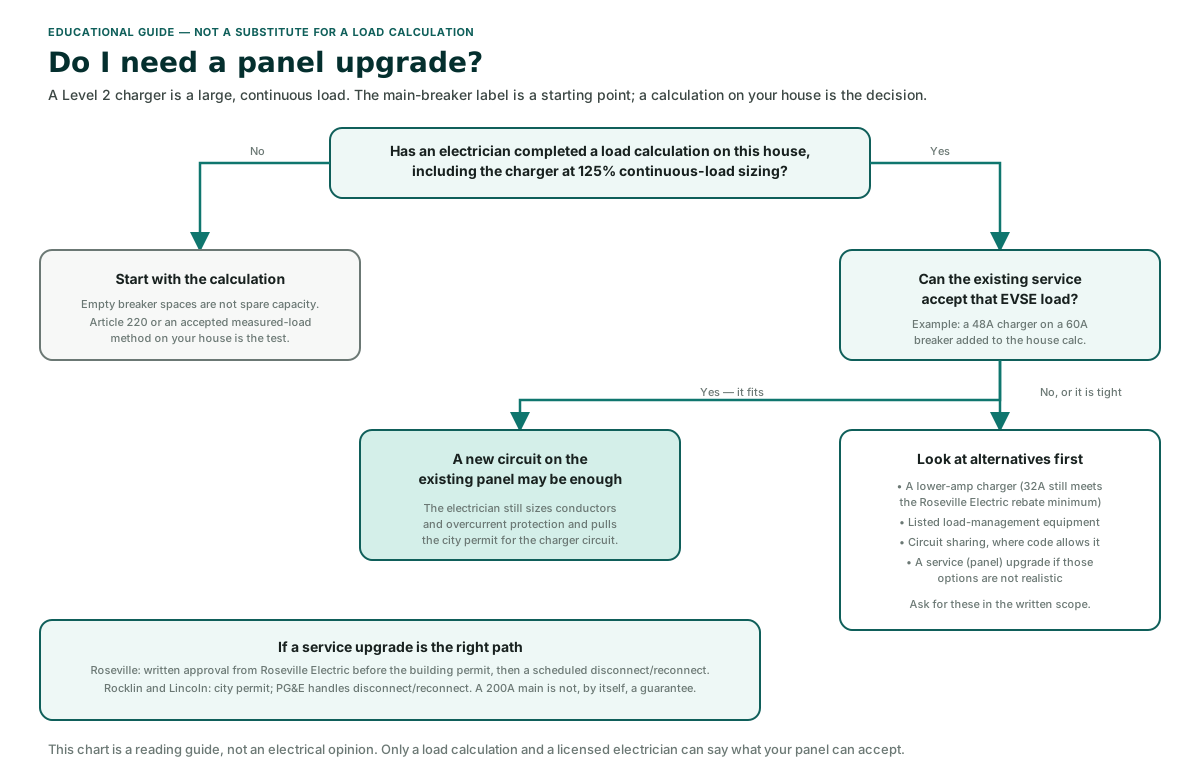
A Level 2 charger is a large, continuous electrical load. Some homes can add it to the existing panel. Others need a load-management device or a service upgrade. This page explains how that decision is made, what 100-amp and 200-amp panels usually imply, and how the process differs in Roseville versus Rocklin and Lincoln.
Why a charger can fill a panel that “looks like it has room”
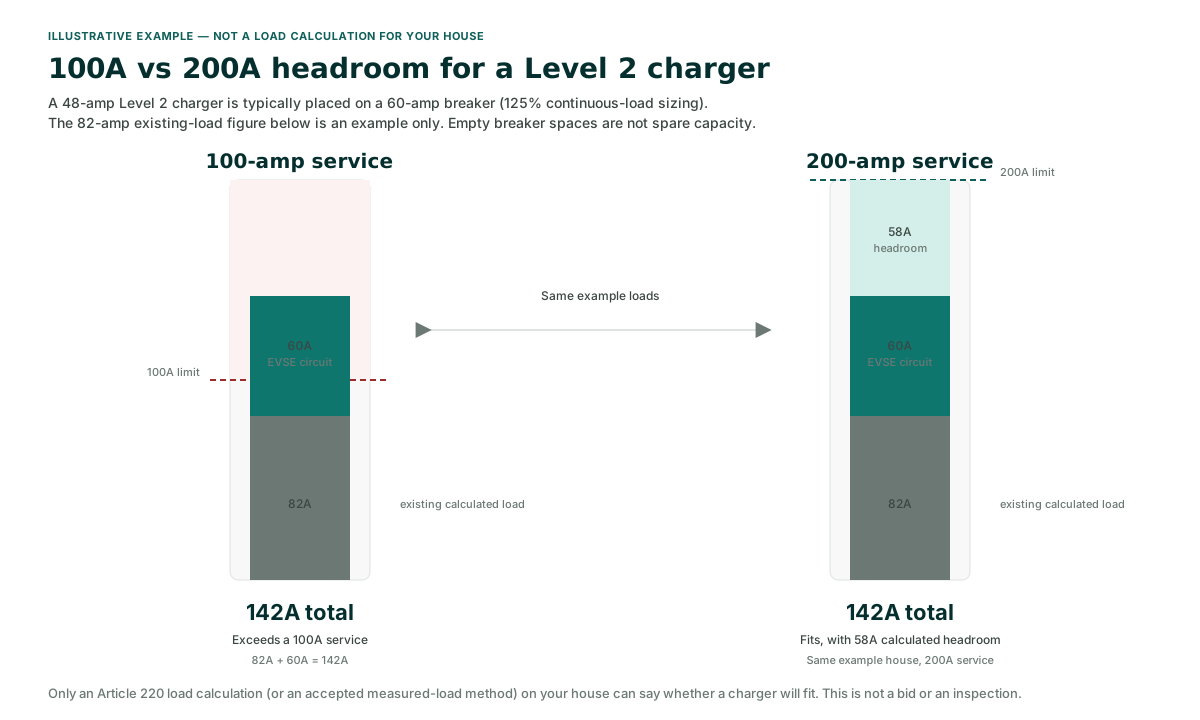
Empty breaker spaces are not the same thing as spare capacity. The National Electrical Code’s Article 220 load calculation adds up a dwelling’s lighting, general-use, and appliance loads, with demand factors, and then adds new equipment. The U.S. Department of Energy’s Alternative Fuels Data Center notes that EV charging infrastructure is considered a continuous load, and that most of the applicable rules sit in NEC Article 625. Continuous loads are generally sized at 125% for conductors and overcurrent protection.
In practical terms, a 40-amp charger is often placed on a 50-amp breaker, and a 48-amp charger on a 60-amp breaker. That 50- or 60-amp figure is what gets added to the house calculation — not the smaller “charge current” number in a marketing brochure. Roseville, Rocklin, and Lincoln EVSE checklists all ask for existing service rating, the calculated or connected load, and the EVSE circuit size, which is the same idea written into a permit form.
100-amp vs 200-amp realities
A 100-amp main is common on older houses. After a central air conditioner, electric range, and clothes dryer are counted, there may not be enough calculated room for a 40- to 60-amp continuous EVSE load. That does not mean a charger is impossible. It does mean the electrician should show the math, not just glance at the deadfront.
A 200-amp service is typical on many homes built in later production phases around Roseville, Rocklin, and Lincoln, and it is the size many electricians hope to see. It is more likely to accept a Level 2 circuit without a service change, especially if the house is still partly gas-fueled. It is not a guarantee. Added heat pumps, an accessory dwelling unit, a shop, or a swimming pool can use that headroom up.
Other sizes (125-amp, 150-amp, 400-amp) show up too. The label on the main breaker is the starting point; a load calculation is the decision.
Alternatives to a full service upgrade
If the calculation is tight, common options include:
- A lower-amp charger (for example, 32 amps on a 40-amp breaker). Overnight charging may still cover a typical commute. Note that Roseville Electric’s charger rebate requires a minimum 32-amp unit, so dropping below that can cost the rebate.
- A listed load-management or energy-management system that reduces charging current when the house is already drawing more power. EnergySage has cited a typical cost around $1,200 — often less than a service upgrade, but still a real line item.
- Circuit sharing with another large appliance, such as a dryer, so both do not run at full load at the same time, where the code and the inspector allow it.
- A subpanel if the issue is a full interior panel rather than the service size itself. EnergySage cited $400–$2,000 for a subpanel, depending on amperage and complexity.
A conscientious electrician will explain which of those are realistic on your panel before recommending a full 200-amp (or larger) service change.
If a service upgrade is the right path
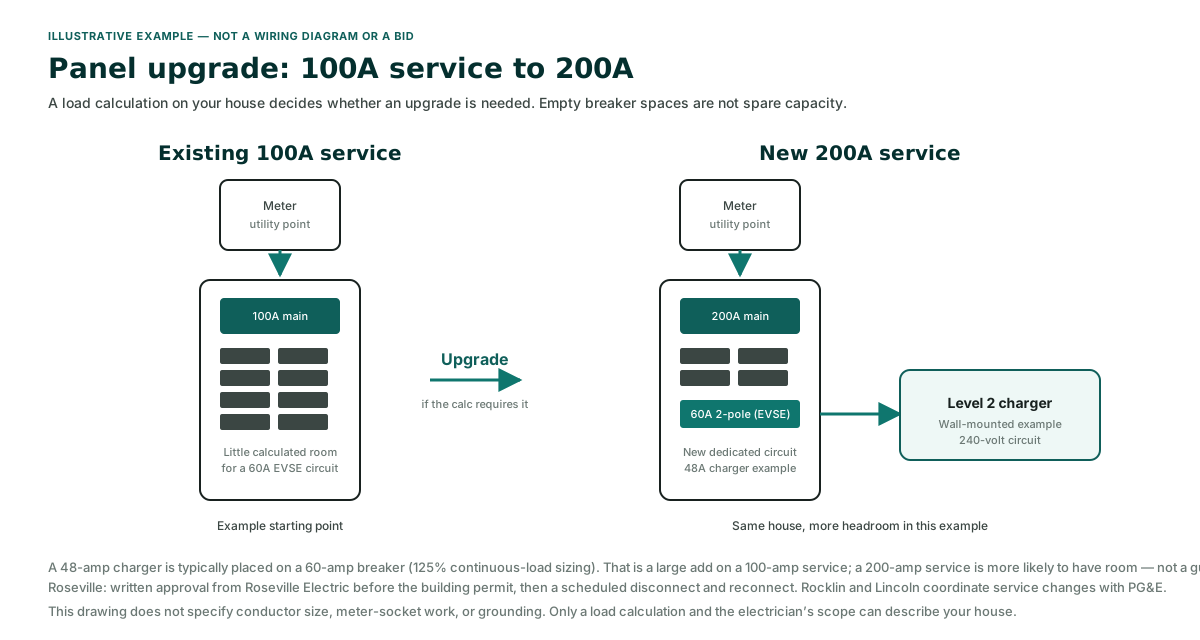
Published cost ranges for this work also disagree, and none of them is a Placer County bid. EnergySage describes a service upgrade to 200 amps as $3,000 or more and notes that it may involve the utility and take weeks. Angi budgets $800–$2,000 for a panel upgrade in its 2026 EV-charger cost guide, and a broader Angi electrical-panel article has used $1,300–$2,000 for a 200-amp upgrade. Treat the spread as a signal to get a local written quote. California service upgrades can also involve meter-socket or service-conductor work that is easy to underestimate from a national midpoint.
Roseville (Roseville Electric)
The City of Roseville’s Residential Electric Service Upgrade / Panel Replacement Procedure is specific:
- Before applying for the building permit, contact Roseville Electric New Service Division at [email protected] or (916) 797-6937 with your name, address, existing panel size, proposed panel size, and whether the service is underground or overhead. The handout says to allow three working days for the approval form.
- After Roseville Electric approves the location/service and sends that approval to Building Inspection, you obtain the electrical permit. A service downgrade requires a load-calculation form from Building Inspection.
- When construction is about to start, contact Roseville Electric Dispatch at (916) 774-5620 at least three working days ahead to schedule the disconnect/reconnect. Inspection is coordinated the same day so the inspector can issue a “green tag” that Roseville Electric requires before setting the meter.
Roseville Electric also offers a panel-replacement rebate of up to $1,000, with a final building permit required. The program lists dedicated circuits for several electrification appliances including a Level 2 EV charger. Whether one or all of those circuits are required, and whether the panel rebate stacks with the charger rebate, is still verify — ask the utility before you count on the money. Details are on the rebate guide.
Rocklin and Lincoln (PG&E)
These cities are typically PG&E electric territory. The City of Rocklin says a permit is required for an electrical service upgrade, that PG&E should be contacted about fees, requirements, and disconnect/reconnect, and that work cannot start until the building permit is issued. An electric load worksheet may be required. The City of Lincoln’s EV charging-station handout requires a single-line diagram that includes main-panel size and disconnects, and it requires existing equipment to be free of electrical hazards before the new circuit is added.
PG&E’s income-qualified Rebate Plus path lists up to $5,000 when a panel upgrade and installation of an eligible charger are combined, with the application filed before a Trade Ally Network contractor buys and installs the equipment. The standard (non-income-qualified) rebate is up to 50% of the charger purchase price and does not, on the pages we checked, replace that larger panel figure. Confirm current terms with PG&E.
What to have ready for the electrician
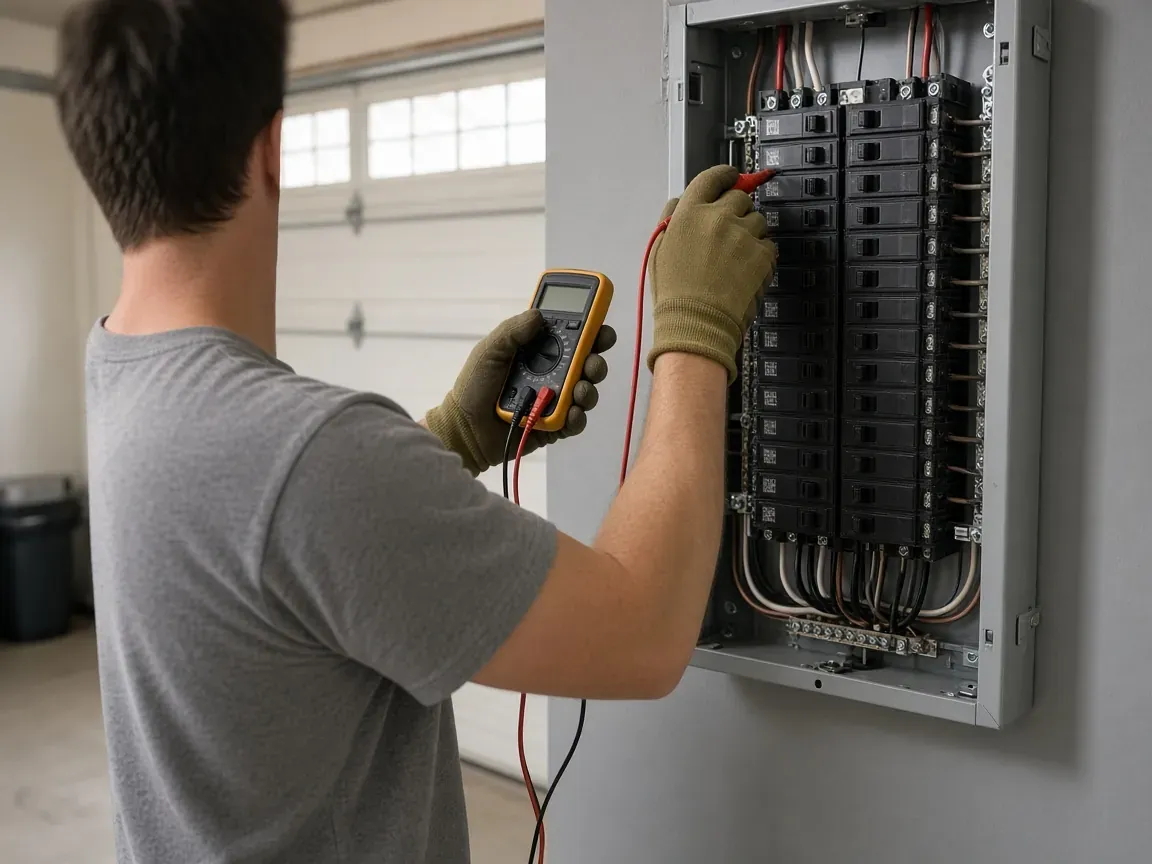
- A clear photo of the panel interior (cover off, only if you can do that safely — otherwise leave it for the electrician) and of the main breaker label.
- The path you want from the panel to the parking spot, including any finished rooms, attic, or exterior walls in between.
- The EV model and the charger you prefer, or a statement that you want a recommendation that can meet rebate specs.
- Whether you already have solar, a battery, or a generator interlock, which changes how a panel is evaluated.
Request a quote
A local licensed electrician can review your panel, run length, and charger choice and give you a written scope. There is no obligation to hire anyone.