Level 2 EV charger installation in Loomis, CA
Loomis is a small incorporated town between Rocklin and Granite Bay, and it has its own building department. A home Level 2 charger here is typically a Town of Loomis permit and a PG&E rebate path — often with Pioneer Community Energy as the generation supplier — not a Roseville Electric job.
An incorporated town with its own building division
The Town of Loomis is an incorporated municipality in Placer County. It borders the City of Rocklin and the census-designated places of Penryn and Granite Bay. The 2020 Census counted 6,836 residents in a town of about 7.27 square miles of land. The ZIP code is 95650. Building permits for work inside the town, including EV chargers, are issued by the Town of Loomis Building Division, not by Rocklin, not by the City of Roseville, and not — for parcels inside the town — by Placer County. Unincorporated land just outside the town limit would go through the county instead; confirm the jurisdiction on your tax bill.
That local-control point is easy to miss because Loomis is small and sits against larger neighbors. A Loomis mailing address does not put the house on Roseville Electric, and a location near the Rocklin line does not move the permit to Rocklin’s eTRAKiT system.
Utility: typically PG&E, often with Pioneer Community Energy
PG&E’s published electric service-area list includes Loomis in Placer County. Pioneer Community Energy says it began serving the Town of Loomis in 2018 and counts close to 3,000 Loomis customers. Pioneer is a community choice aggregator: it supplies generation, while PG&E still delivers the electricity and is the utility named in PG&E’s Residential EV Charging rebate. That rebate includes CCA customers who meet the program rules. Roseville Electric charger and panel rebates require a Roseville Electric residential account. If the bill says PG&E, use PG&E’s programs, including for any service upgrade. Check the bill near the edges of town rather than assuming based on a nearby landmark.
Town of Loomis permits and inspections
The Building Division accepts project submittals by email at [email protected]. The published permit-technician number is (916) 652-1840. Office hours listed on the town’s electrical-permit and building-division pages are Monday through Thursday, and the office is closed to the public on Friday. The town states that project submittals received after January 1, 2026, must be submitted under the 2025 Building Code.
For EV chargers, the electrical-permit page lists four items at submittal:
- A building permit application.
- A complete site plan (the town links to its site-plan requirements).
- The residential EV charging checklist. The town also posts a fillable “Residential Expedited EV Charging” form, dated March 21, 2023, among its building forms — the expedited checklist used for these jobs.
- A declaration of installation of smoke and carbon monoxide alarms.
Files must be digital, clear, and complete; the town says incomplete applications will not be accepted, and that images or photo attachments will not be accepted as plans. If the combined files exceed 25 MB, the town asks for a cloud-storage link rather than a large email. After a project is accepted, the applicant may be told how to pay a plan-check deposit, which is applied to plan-check fees. Correction comments come as a plan-correction letter, and the town will not accept partial resubmittals. If the applicant is not the contractor or the legal property owner, a signed authorization letter is required.
Contractors performing work in the town must have an active Town of Loomis business license and be in good standing with the California Contractors State License Board. The town says a building permit will not be processed without that. Inspections are scheduled through the town’s inspection page at loomis.ca.gov/inspections. The building-division and electrical-permit pages have listed slightly different weekday inspection schedules, so confirm current inspection days with the division when the permit is issued rather than relying on a remembered weekday.
California law (Government Code sections 65850.7 and 65850.71) requires cities and counties — and a town in this context — to use an expedited, ministerial review of EV charging-station applications, limited to health and safety. Loomis’s published residential expedited EV charging checklist is the local document that supports that path. Confirm any additional current instructions with the Building Division.
If the job also changes the service or derates a panel, the paperwork changes. For electrical panels, the town asks for a building permit application, an electrical load calculation form when the panel is being derated, and the smoke and carbon monoxide alarm declaration. Ask the division how to combine a charger and a panel change in one submittal before you email the files.
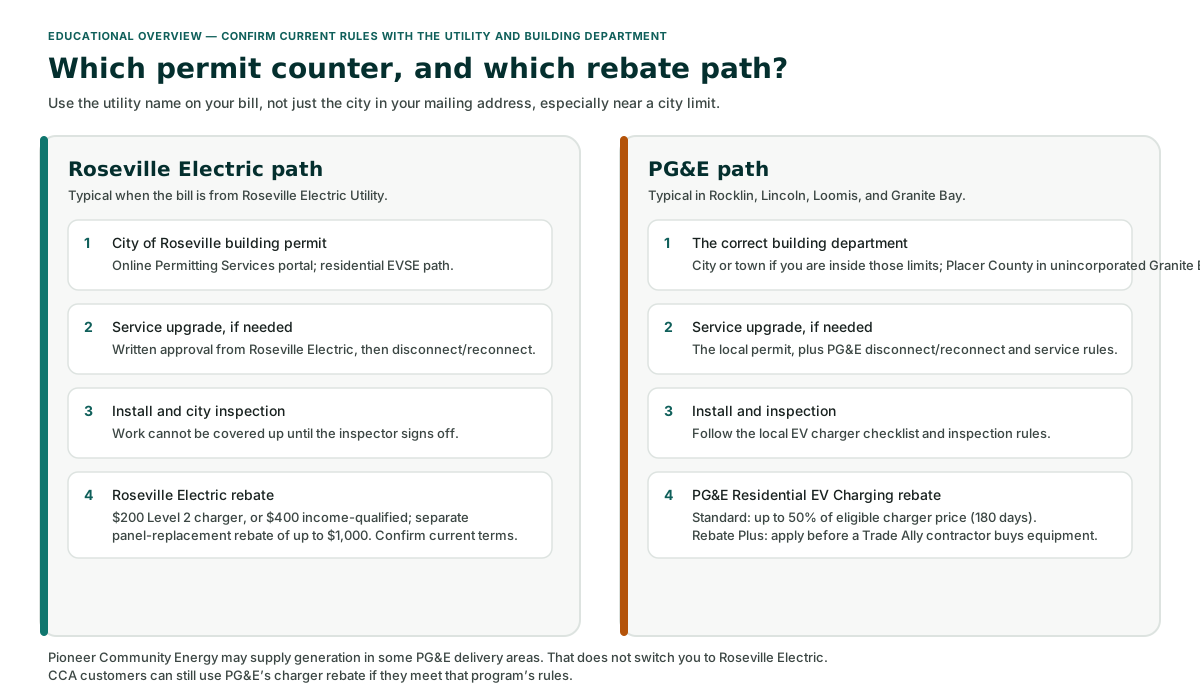
PG&E rebates, and the closed federal credit
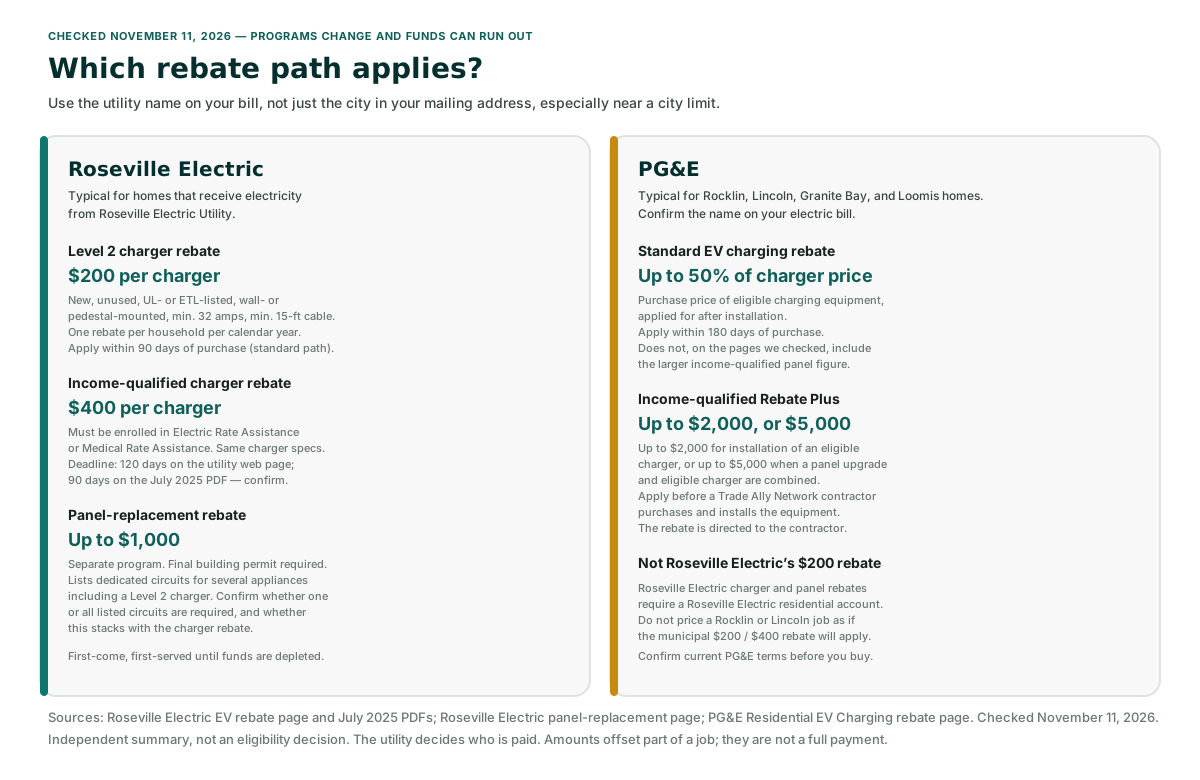
The usual incentive is PG&E’s Residential EV Charging rebate (rechecked November 12, 2026):
- Standard: up to 50% of the purchase price of eligible charging equipment, after installation, within 180 days of purchase.
- Rebate Plus (income-qualified or certain program participation): apply before a Trade Ally Network contractor purchases and installs the equipment. Up to $2,000 for installation of an eligible charger, or up to $5,000 when a panel upgrade is included.
You will need the PG&E account number and Service Agreement ID, current California vehicle registration at the service address, and, for the standard path, proof of purchase and photos of the installed equipment. Confirm eligible equipment and current amounts on PG&E’s site. There is not a statewide California Energy Commission rebate that replaces that utility program for a typical home install. The federal Alternative Fuel Vehicle Refueling Property Credit (26 U.S.C. § 30C) is not allowed for property placed in service after June 30, 2026, per IRS FAQs on Public Law 119-21. This site does not give tax advice.
Cost context (ranges, not a Loomis quote)
Published national figures are starting points, not bids. EnergySage, citing Qmerit 2025 data, reported an average of $2,442. Angi, citing 2026 project data, reported a national average of $967 with a typical range of $555–$1,380, plus $800–$2,000 if a panel upgrade is needed. The cost guide explains why those midpoints disagree. In Loomis, the cost drivers that most often pull a job off a short-garage midpoint are run length on larger lots, the condition and size of an older service, and whether a detached building already has — or needs — a subpanel. A written, itemized estimate should show that path.
Housing stock, long runs, and load calculations
Loomis has a lower-density pattern than a typical small-lot subdivision: 6,836 residents in about 7.3 square miles, according to 2020 Census population and land-area figures. The town includes an older central area along the historic rail and highway corridor and larger residential properties farther from that core. This site is not going to invent a typical Loomis panel size or a typical acreage. What can be said, as general guidance, is that a longer run to a detached garage, shop, or parking pad, or an existing subpanel at an outbuilding, changes the design and the cost, and that older services in the town center can be tight once a continuous Level 2 load is added.
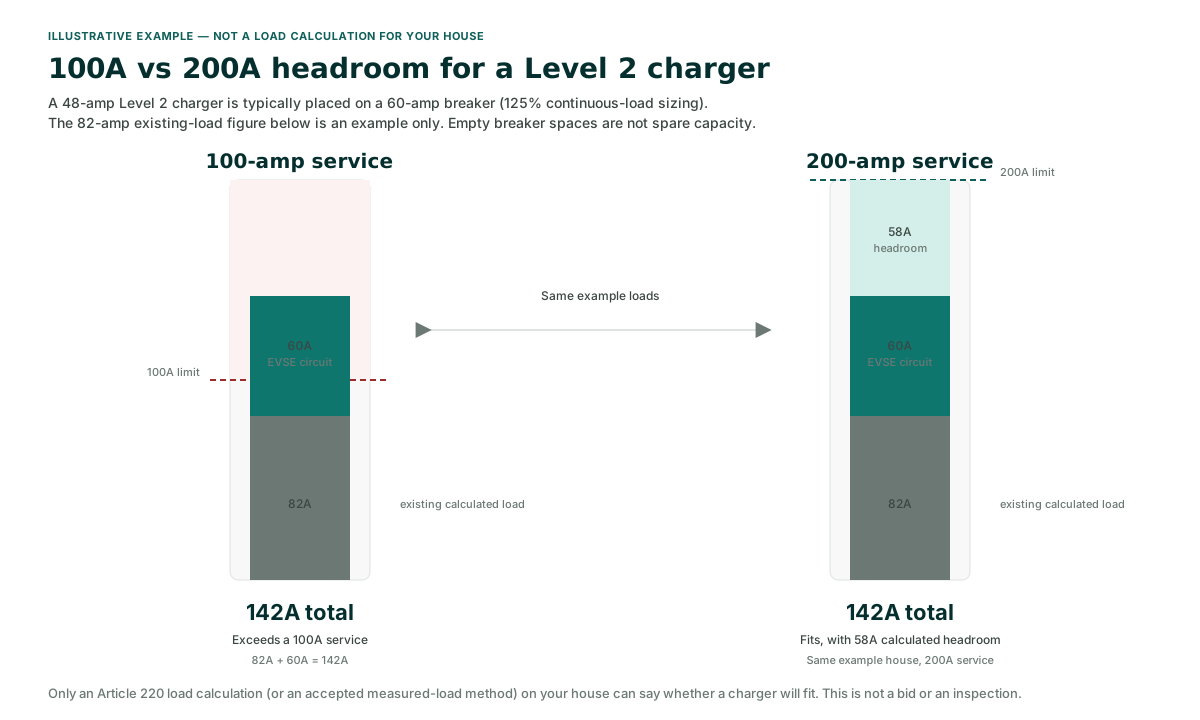
A Level 2 charger is commonly served by a 40- to 60-amp breaker because of 125% continuous-load sizing. That can exceed the spare capacity on a 100-amp service that already runs HVAC, a range, and a dryer. Empty breaker spaces are not spare capacity. The panel upgrade guide covers the calculation and alternatives such as a lower-amp charger or load management. If a service upgrade is needed, the town issues the permit and PG&E handles utility disconnect and reconnect. The Roseville Electric panel-replacement rebate does not apply on a PG&E service.
Where a property has an association, California Civil Code section 4745 requires the association to process an EV charging-station request like other architectural modifications, in writing. That review does not replace the town permit.
What to expect
Follow the sequence in the what-to-expect guide, with the Town of Loomis and PG&E in place of Roseville’s permit portal and Roseville Electric: photos of the panel and the parking spot, a load calculation, an email submittal that includes the site plan and the residential EV checklist, install, inspection, then the PG&E rebate. If the charger will sit far from the main panel, say so at the outset. If you plan to use Rebate Plus, start that application before the contractor buys the equipment. Contractors should have the town business license in hand before the permit is filed.
This site does not have partner job photos or reviews from Loomis, and it will not invent them or use photographs that could be mistaken for downtown Loomis, a fruit-shed landmark, or “our work.” When a partner is in place, original photos can be added. For equipment and connector questions, see Tesla Wall Connector vs J1772 / NACS and use PG&E’s eligible-equipment list unless your bill is actually Roseville Electric.
Nearby areas
Loomis has its own building division and an email-based permit path. The homepage is the Roseville guide. Unincorporated parcels next to town, including much of Granite Bay, go through Placer County rather than the town.
- Roseville — typically Roseville Electric; start on the homepage.
- Rocklin — Level 2 charger installation in Rocklin: City of Rocklin permits and a typical PG&E rebate path.
- Lincoln — Level 2 charger installation in Lincoln: City of Lincoln permits and a typical PG&E rebate path.
- Granite Bay — Level 2 charger installation in unincorporated Granite Bay: Placer County permits and a typical PG&E rebate path.
Licensed electricians A neutral, unranked list of C-10 contractors whose own sites name Roseville, Rocklin, Lincoln, Granite Bay, or Loomis, with CSLB license numbers checked on November 12, 2026.
Questions specific to this area
Who issues an EV charger permit in Loomis?
The Town of Loomis Building Division, not the City of Roseville and not Placer County, issues building permits inside the town limits. For an EV charger, the town asks for a building permit application, a complete site plan, the residential EV charging checklist, and a declaration of installation of smoke and carbon monoxide alarms. Submittals go by email to [email protected]. Unincorporated land outside the town would go through Placer County instead; confirm the jurisdiction on your tax bill.
Is Loomis on Roseville Electric or PG&E?
Loomis homes are typically PG&E electric customers, often with Pioneer Community Energy as the generation supplier. PG&E’s service-territory list includes Loomis, and Pioneer says it began serving the town in 2018. Roseville Electric rebates require a Roseville Electric residential account. The town’s ZIP is 95650. Check the utility name on the bill, especially near the Rocklin or Roseville edges of town.
What code year does Loomis use, and do contractors need a town license?
The Building Division states that project submittals received after January 1, 2026, must be submitted under the 2025 Building Code. Contractors working in the town must have an active Town of Loomis business license and be in good standing with the California Contractors State License Board; the town says a building permit will not be processed without that. Inspections are scheduled through the town’s inspection page. Confirm current inspection days with the Building Division.
Which rebate applies in Loomis?
PG&E’s Residential EV Charging rebate is the usual path: up to 50% of the eligible charger purchase price after installation (apply within 180 days), or income-qualified Rebate Plus of up to $2,000 for installation or up to $5,000 with a panel upgrade, which must be applied for before a Trade Ally Network contractor buys the equipment. Pioneer customers remain eligible if they meet PG&E’s rules. The federal § 30C credit is not allowed for property placed in service after June 30, 2026. Confirm current terms with PG&E.
Do larger Loomis lots or older downtown houses change the install?
Often, yes, but only a look at the specific property can say how. The town covers about 7.3 square miles and had 6,836 residents in the 2020 Census, a lower-density pattern than a typical small-lot subdivision. Some properties have longer runs to a detached garage, barn, or parking pad, or already have a subpanel at an outbuilding. Older houses near the town center can have tighter panels. Empty breaker spaces are not spare capacity, and a load calculation is the only reliable test.
If I am replacing or changing a panel in Loomis, is the paperwork different?
Yes. For electrical panels, the town’s electrical-permit page asks for a building permit application, an electrical load calculation form when a panel is being derated, and the smoke and carbon monoxide alarm declaration. That is a different packet than the EV charger submittal, which centers on a site plan and the residential EV charging checklist. If the charger job also includes a service or panel change, ask the Building Division which documents to combine before you email the files.
Request a quote
A local licensed electrician can review your panel, run length, and charger choice and give you a written scope. There is no obligation to hire anyone.