Level 2 EV charger installation in Granite Bay, CA
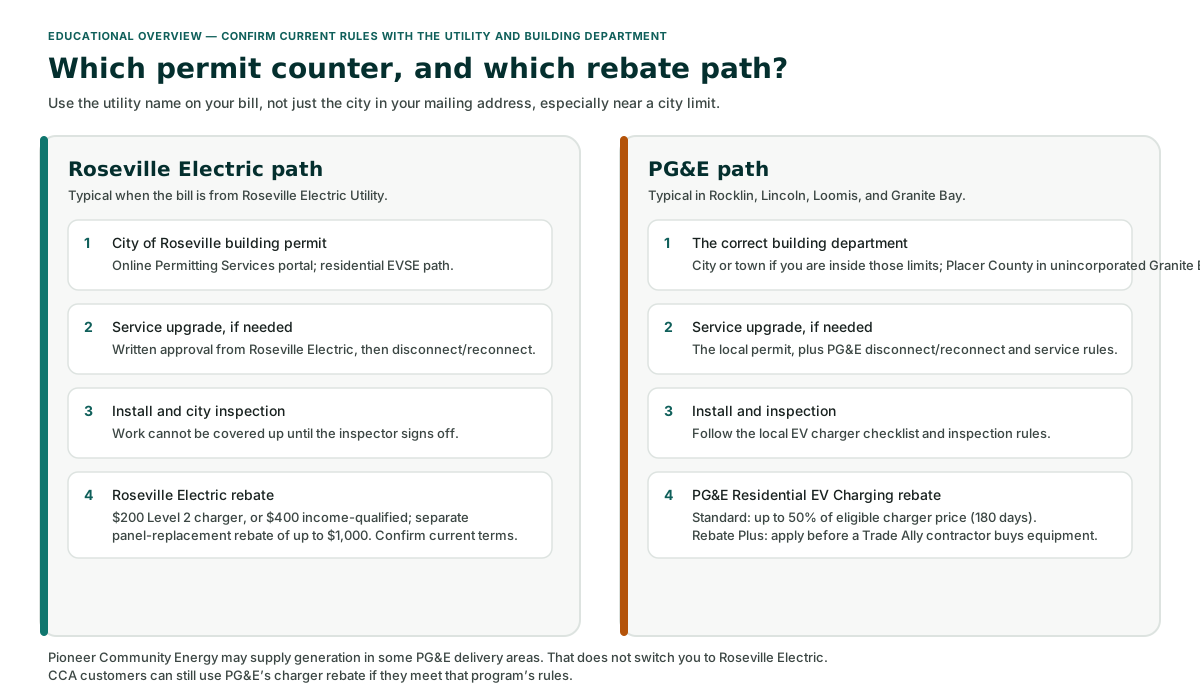
Granite Bay is not a city, and it is not on Roseville Electric just because it sits next to Roseville. A home Level 2 charger here is typically a Placer County building permit and a PG&E rebate path. The homepage remains the guide for Roseville addresses that actually receive power from Roseville Electric.
Unincorporated Granite Bay, not a city permit counter
Granite Bay is a census-designated place in Placer County, immediately east of Roseville and west of Folsom Lake. The 2020 Census counted 21,247 residents across about 21.5 square miles of land. Building permits for a home charger are issued by Placer County Building Services, not by a Granite Bay city hall and not, for unincorporated parcels, by the City of Roseville. That jurisdictional split is the fact most often missed when a Granite Bay address is discussed next to a Roseville one.
The primary ZIP is 95746. Some listings also associate 95661, which is a ZIP used in Roseville. PG&E’s electric tariff maps list service in all or portions of several Roseville-named ZIPs, including 95746. None of those lists replaces a look at the tax bill (who the building official is) and the electric bill (who the utility is). Homes just inside the Roseville city limit follow the Roseville homepage. Homes just inside the Town of Loomis follow the town’s permit path.
Utility: typically PG&E
PG&E’s published electric service-area list includes Granite Bay in Placer County. Roseville Electric charger and panel rebates require a residential account that receives electricity from Roseville Electric Utility. If the bill says PG&E, use PG&E’s programs and PG&E’s process for any service upgrade.
Pioneer Community Energy, a community choice aggregator, serves Auburn, Colfax, Lincoln, Rocklin, the Town of Loomis, and most of unincorporated Placer County. Pioneer does not specifically name Granite Bay on its “who we serve” page, so this site does not assume every Granite Bay house is a Pioneer customer. Check the generation line on the PG&E bill. If Pioneer (or another CCA) is the supplier, PG&E still delivers the power, and PG&E’s Residential EV Charging rebate still includes CCA customers who meet the program rules.
Placer County permits and inspections
In May 2022, the Placer County Board of Supervisors approved a motion to streamline electric vehicle charging-station permits. Building Services said the goal is to issue complete applications over the counter the same day, and it published residential and commercial checklists to support that process. The county’s plan-review page states that electric vehicle charging stations are reviewed over the counter using the Board-approved checklist (April 2022), with a fire-life-safety review only. That approach aligns with California’s statewide streamlining rules under Government Code sections 65850.7 (AB 1236) and 65850.71 (AB 970), which limit ministerial review to health and safety and set default completeness and approval timelines when a local agency does not act.
The residential checklist, available from the county’s EV charging-station page, calls for:
- A completed building permit application.
- Plans, including a floor plan and panel location.
- The electric vehicle charging-station checklist itself.
- An electrical load worksheet if the existing service is less than 150 amps.
- The equipment manufacturer’s installation instructions.
The same checklist asks whether the installation is Level 1 or Level 2, what receptacle (if any) is being installed, the overcurrent-protection rating, and the existing electrical service size (100, 125, 150, or 200 amps). It distinguishes a branch-circuit distance of 100 feet or less from a run of more than 100 feet, and it notes that a receptacle requires GFCI protection and that EVSE rated over 50 amps is required to be hardwired (citing the California Electrical Code). Applications can be submitted through the county’s e-Services platform or in person at Building Services in Auburn, 3091 County Center Drive, (530) 745-3000. If you start online, the county says you need to finish online; paper filings stay on paper.
PG&E rebates, and the closed federal credit
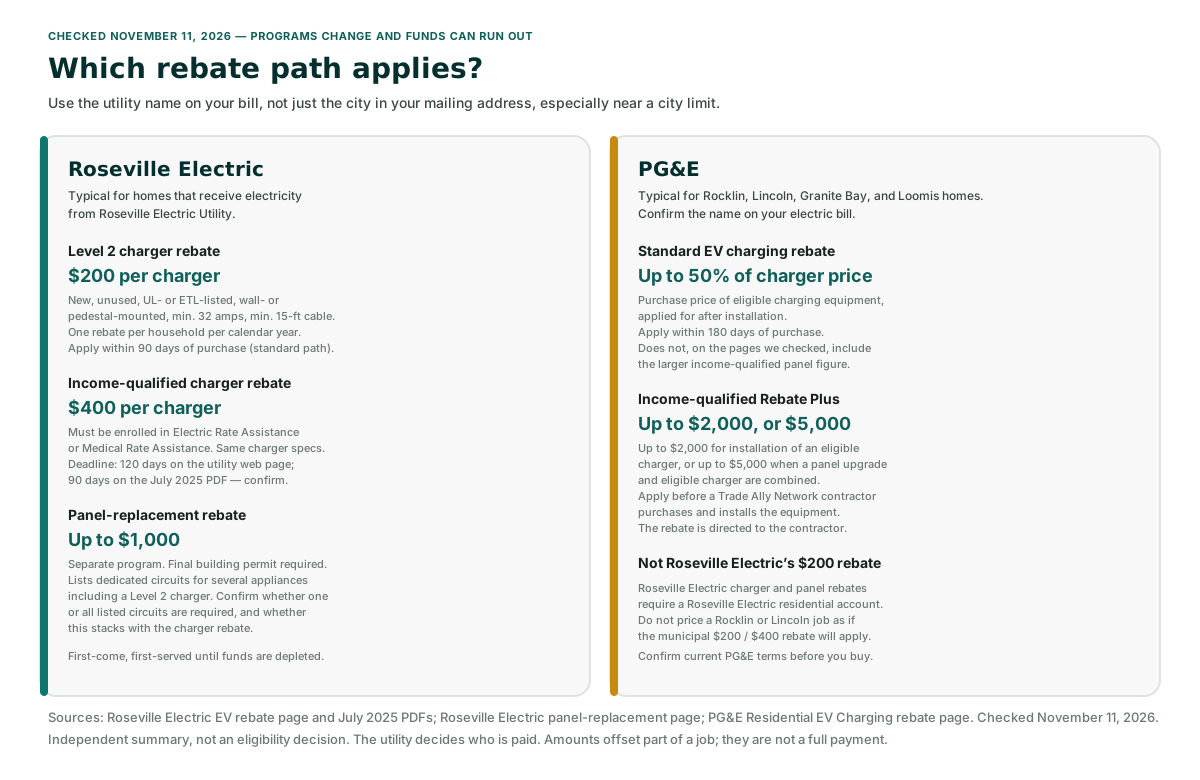
The usual incentive for a Granite Bay home on PG&E is the Residential EV Charging rebate (rechecked November 12, 2026):
- Standard: up to 50% of the purchase price of eligible charging equipment, after installation, within 180 days of purchase.
- Rebate Plus (income-qualified or certain program participation): apply before a Trade Ally Network contractor purchases and installs the equipment. Up to $2,000 for installation of an eligible charger, or up to $5,000 when a panel upgrade is included.
You will need the PG&E account number and Service Agreement ID, current California vehicle registration at the service address, and, for the standard path, proof of purchase and photos of the installed equipment. Confirm eligible equipment and current amounts on PG&E’s site. There is not a statewide California Energy Commission rebate that replaces that utility program for a typical home install. The federal Alternative Fuel Vehicle Refueling Property Credit (26 U.S.C. § 30C) is not allowed for property placed in service after June 30, 2026, according to IRS FAQs on Public Law 119-21. This site does not give tax advice. Roseville Electric’s $200 / $400 charger rebates and up-to-$1,000 panel rebate apply only if the bill is actually Roseville Electric.
Cost context (ranges, not a Granite Bay quote)
Published national figures are not local bids. EnergySage, citing Qmerit 2025 data, reported an average of $2,442. Angi, citing 2026 project data, reported a national average of $967 with a typical range of $555–$1,380, plus $800–$2,000 if a panel upgrade is needed. The cost guide explains why those midpoints disagree. In Granite Bay, run length is often the variable that moves a job off a national midpoint: a detached garage, a parking pad down a long driveway, or a house-mounted panel that has to feed a distant charger can mean a longer feeder, a subpanel, or underground conduit. The county’s own checklist treats runs over 100 feet as a distinct condition. Ask for a written, itemized estimate that shows that path, not only the charger on the wall.
Housing stock, long runs, and load calculations
Placer County’s Granite Bay Community Plan, adopted February 28, 2012, describes a mix of suburban and rural-residential parcel sizes. It characterizes the community’s rural lifestyle in part by “the predominance of large lots in the northern section of the community,” limited commercial development, and proximity to Folsom Lake. The plan’s land-use districts range from rural-estate and rural-residential categories through suburban low- and medium-density residential areas, so lot size is not uniform. That mix is what matters for a charger install. On a larger lot, the electrical service may be on the house while the vehicle parks in a detached garage or along a long drive. On a tighter suburban lot, the run may be short and the main complication is panel capacity.
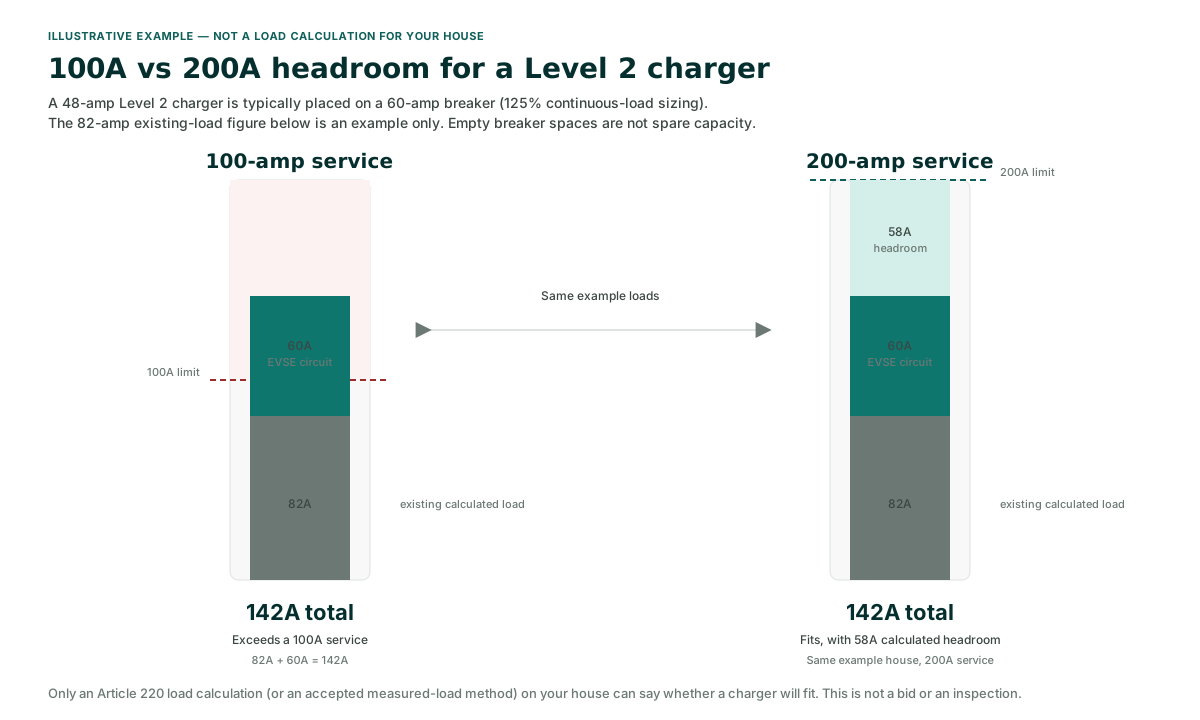
The county checklist’s 150-amp threshold is a useful local cue: if the existing service is less than 150 amps, a load worksheet is part of the submittal. A Level 2 charger is a continuous load and is commonly served by a 40- to 60-amp breaker, which can fill a 100-amp or 125-amp service that already runs HVAC, a range, and a dryer. Empty breaker spaces are not spare capacity. Some larger properties already have a subpanel at a detached building; adding a charger there is a different design than landing a new circuit in a garage attached to the house. The panel upgrade guide covers the math and the alternatives, including load management. If a service upgrade is needed, Placer County issues the permit and PG&E handles utility disconnect and reconnect.
Some Granite Bay subdivisions have homeowners associations. This site is not going to invent a list of those associations or their architectural rules. Where an association exists, California Civil Code section 4745 requires it to process an EV charging-station request like other architectural modifications, in writing. That review does not replace the county permit.
What to expect
The sequence in the what-to-expect guide still holds, with Placer County and PG&E in place of a city building division and Roseville Electric: photos of the panel and the parking spot, a load calculation (and a load worksheet if the service is under 150 amps), a county application through e-Services or the Auburn office, install, inspection, then the PG&E rebate. Measure the run. If it may exceed 100 feet, or if the charger will sit on a detached building, say so in the first conversation with the electrician so the scope is not written as a short garage circuit. If you plan to use Rebate Plus, that application has to start before the contractor buys the equipment.
This site does not have partner job photos or reviews from Granite Bay, and it will not invent them or use photographs that could be mistaken for a local street, a Folsom Lake landmark, or “our work.” When a partner is in place, original photos can be added. For equipment and connector questions, see Tesla Wall Connector vs J1772 / NACS and use PG&E’s eligible-equipment list unless your bill is actually Roseville Electric.
Nearby areas
Granite Bay’s permit counter is Placer County Building Services, which is the main difference from the incorporated cities nearby. The homepage is the Roseville guide. Use the pages below when the parcel is inside a city or town limit.
- Roseville — typically Roseville Electric; start on the homepage.
- Rocklin — Level 2 charger installation in Rocklin: City of Rocklin permits and a typical PG&E rebate path.
- Lincoln — Level 2 charger installation in Lincoln: City of Lincoln permits and a typical PG&E rebate path.
- Loomis — Level 2 charger installation in the Town of Loomis: town permits and a typical PG&E rebate path.
Licensed electricians A neutral, unranked list of C-10 contractors whose own sites name Roseville, Rocklin, Lincoln, Granite Bay, or Loomis, with CSLB license numbers checked on November 12, 2026.
Questions specific to this area
Who issues an EV charger permit in Granite Bay?
Granite Bay is an unincorporated census-designated place in Placer County, not a city with its own building department. Residential EV charger permits are issued by Placer County Building Services, not the City of Roseville. Applications can be submitted through the county’s e-Services platform or in person at the Auburn office, 3091 County Center Drive, (530) 745-3000. Confirm you are in unincorporated county jurisdiction on your tax bill, especially near the Roseville city limit.
Is Granite Bay on Roseville Electric or PG&E?
Granite Bay homes are typically PG&E electric customers. PG&E’s service-territory list includes Granite Bay, and Roseville Electric rebates require a Roseville Electric residential account. The primary Granite Bay ZIP is 95746. Some addresses near the Roseville edge are also associated with 95661, which is a Roseville ZIP, so a mailing address is not a reliable guide. Check the utility name on the bill and the jurisdiction on the tax bill.
What does Placer County require for a residential EV charger?
The county publishes a residential EV charging-station checklist and aims to issue complete applications over the counter the same day, with review limited to fire and life safety. The checklist asks for a building permit application, a floor plan and panel location, the EV checklist itself, manufacturer’s installation instructions, and an electrical load worksheet if the existing service is less than 150 amps. It also distinguishes branch-circuit runs of 100 feet or less from runs of more than 100 feet, which matters on larger lots.
Which rebate applies in Granite Bay?
PG&E’s Residential EV Charging rebate is the usual path: up to 50% of the eligible charger purchase price after installation (apply within 180 days), or income-qualified Rebate Plus of up to $2,000 for installation or up to $5,000 with a panel upgrade, which must be applied for before a Trade Ally Network contractor buys the equipment. Pioneer Community Energy serves most of unincorporated Placer County; check the generation line on your bill. CCA customers can still use the PG&E rebate if they meet the program rules. The federal § 30C credit is not allowed for property placed in service after June 30, 2026.
Why do larger Granite Bay lots change the install?
The 2012 Granite Bay Community Plan describes a mix of suburban and rural-residential parcel sizes, with a predominance of large lots in the northern section of the community and proximity to Folsom Lake. On a larger lot, the panel may be on the house while the parking is in a detached garage or down a long driveway. That can mean a long feeder, a subpanel, or underground conduit. The county checklist specifically asks whether the branch circuit is more than 100 feet. Those conditions affect cost and design; they are not a bid for any one property.
Do I still need a permit if I am close to Roseville or Loomis?
Yes, if the work requires one, but the counter depends on the parcel. Inside the City of Roseville, the City of Roseville issues the permit and Roseville Electric is often the utility. Inside the Town of Loomis, the town issues the permit. In unincorporated Granite Bay, Placer County issues the permit. Do not assume based on a nearby landmark or a mailing address. Check the tax bill and the utility bill before anyone files.
Request a quote
A local licensed electrician can review your panel, run length, and charger choice and give you a written scope. There is no obligation to hire anyone.